





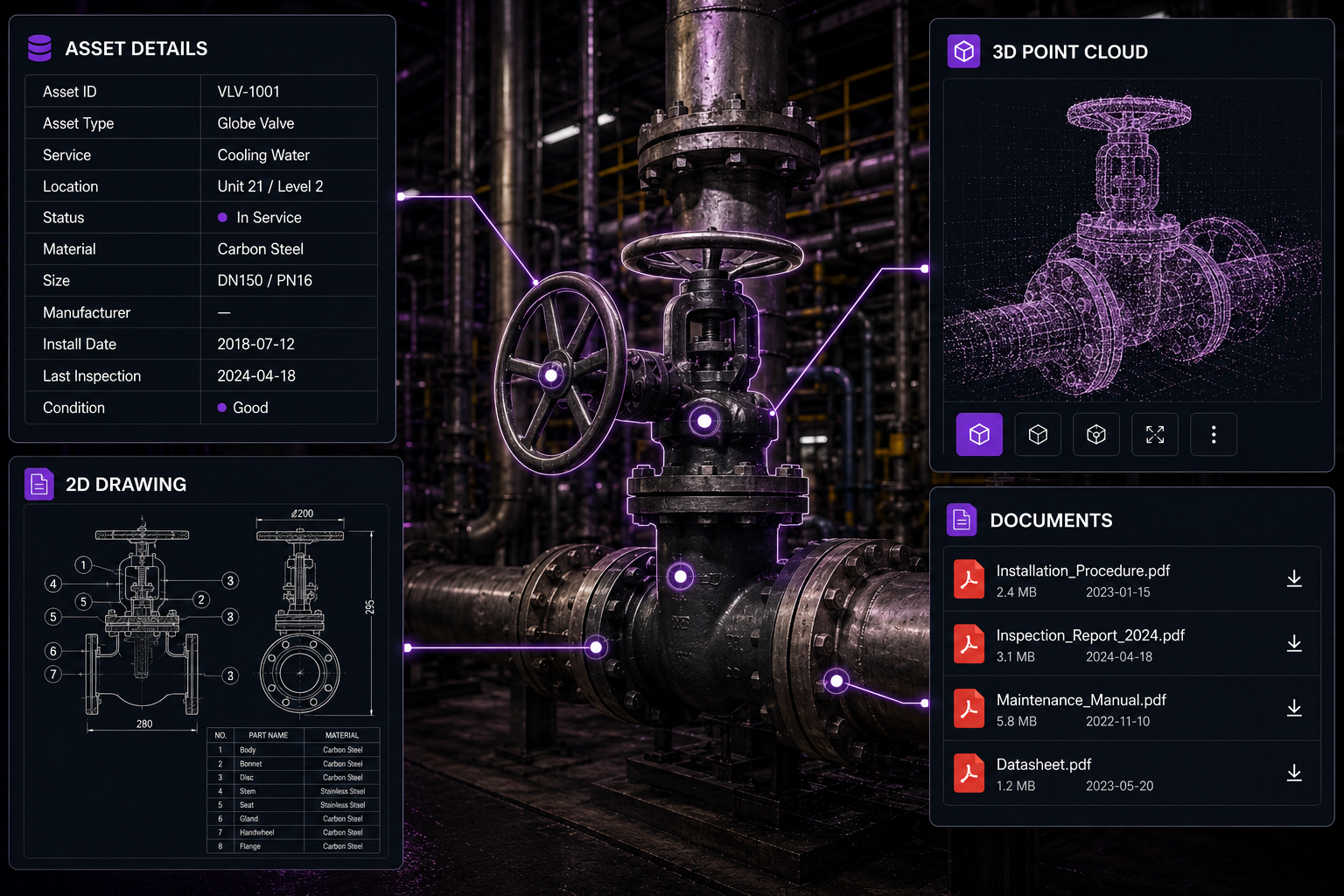
Connecting 1D, 2D and 3D Infrastructure Information
Once infrastructure reality is captured and engineering information is validated, the next critical step is transforming fragmented datasets into connected and structured infrastructure intelligence. Virtual Plant® achieves this by creating an object-based digital environment where assets, documents, locations and operational information become interconnected within a single source of truth.
In many industrial environments, information exists across disconnected systems, isolated documents, legacy engineering files and operational databases. Even when digital data is available, relationships between assets, documents and field reality are often missing or inconsistent. This makes navigation, understanding and decision-making difficult, especially in large brownfield facilities and multi-site operations.
Virtual Plant® addresses this challenge through engineering-driven asset tagging, structuring and contextualization workflows that transform raw captured data into usable operational intelligence.
Object-Based Infrastructure Intelligence
At the core of Virtual Plant® is an object-based infrastructure model where every identifiable asset, component and infrastructure element can become part of a connected intelligence environment.
Unlike traditional approaches where only selected major equipment is tagged or structured, Virtual Plant® enables even smaller infrastructure elements to receive their own digital identity and contextual relationships. Pipes, valves, instruments, cable routes, junction boxes, supports, underground utilities and other infrastructure components can all become individually accessible and traceable objects within the platform.
This significantly increases infrastructure visibility and reduces the hidden information gaps that commonly exist in brownfield environments.
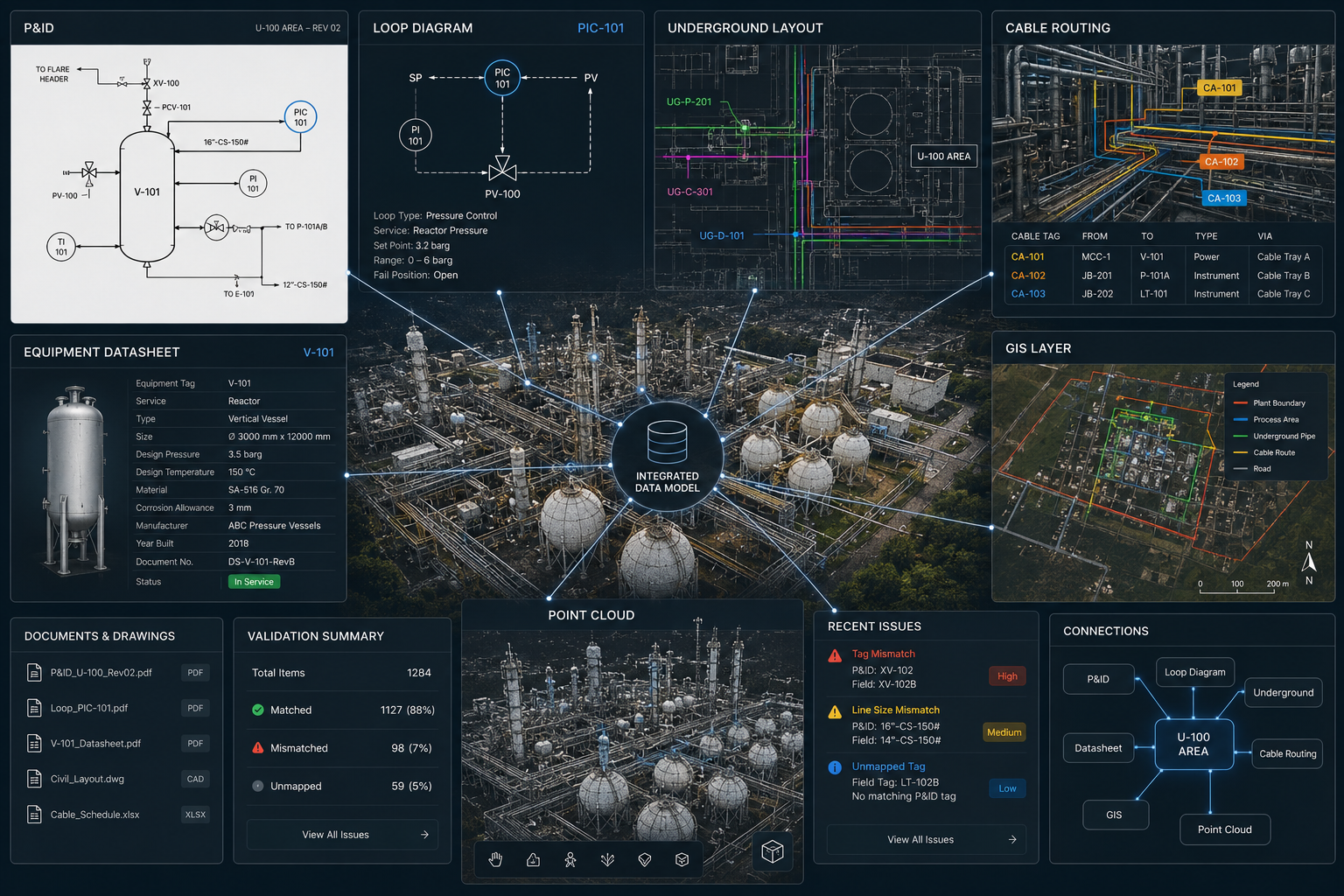
Building a Trusted Single Source of Truth
Industrial infrastructure information exists across multiple dimensions:
- 1D operational and asset data
- 2D engineering documentation
- 3D spatial reality and field conditions
Virtual Plant® connects these information layers into a unified infrastructure intelligence environment.
Engineering documents such as P&IDs, loop diagrams, cable routing drawings, underground layouts and asset registers are linked directly to corresponding field assets and spatial infrastructure objects. Tagged objects within documents become connected to their physical counterparts inside the captured environment.


Continuous Cross-Validation of Infrastructure Data
The structuring and tagging process itself also creates an additional layer of infrastructure validation.
As engineering documents, captured reality and operational data become interconnected object-by-object, inconsistencies, missing information and undocumented assets become significantly easier to identify. This cross-checking methodology helps reduce the probability of overlooked infrastructure elements and improves overall confidence in the resulting digital foundation.
In many brownfield environments, even basic infrastructure components may have never been properly tagged, structured or connected digitally. Virtual Plant® enables organizations to progressively establish a far more complete and validated infrastructure inventory than traditional approaches typically allow.
Engineering-Driven Asset Libraries & Standardization
Asset structures and tagging methodologies are developed using both industry standards and customer-specific engineering practices. Virtual Plant® supports the creation of scalable asset libraries aligned with operational workflows, engineering requirements and existing company standards.
For organizations operating multiple facilities across different regions or business units, this creates a major opportunity for infrastructure standardization and operational alignment.
Instead of each site evolving independently with different naming conventions, inconsistent asset structures and fragmented documentation approaches, Virtual Plant® helps establish a connected infrastructure intelligence framework across distributed operations.
This enables:
- Standardized asset structures
- Consistent tagging methodologies
- Unified infrastructure visibility
- Improved operational alignment
- Easier scaling of digital initiatives
- Better data governance
- More reliable enterprise-wide infrastructure intelligence